Wed 7pm, Sat 2pm
Don is in conversation with Colonel Don Christensen, USAF (ret.) who is an expert on Military Sexual Trauma

Wed 7pm, Sat 2pm
Don is in conversation with Colonel Don Christensen, USAF (ret.) who is an expert on Military Sexual Trauma

Conservation Groups Protest Proposal to Swap Out Land in Yosemite
By Suzanne Potter
Sep 16, 2026
California lawmakers are leading the charge against a proposed land swap to allow a road to be built in Yosemite National Park, connecting it with a planned development just over the park border.
More than 150 lawmakers, including Sen. Alex Padilla, D-Calif., and Sen. Adam Schiff, D-Calif., just wrote to Interior Secretary Doug Burgum, arguing national parks should not be carved up for private interests.
Lanny Davis, an attorney for the developer Kingsbarn Realty Capital, said he is negotiating with park officials to build a road through a few acres in the park to connect the developer’s property with Highway 120.
David Willms, associate vice president of public lands for the National Wildlife Federation, said the acreage is not the point.
“It’s the precedent that it sets to say that this is OK and it’s something we would consider doing in other parks around the country,” Willms contended. “Who knows if the next proposal would be larger or not?”
The developer has not released specific plans but has considered building a lodge and cabins in the past. Davis claimed in a statement the road would reduce air pollution because the shortcut would reduce the time vehicles take to reach the development. A similar proposal was rejected during several prior administrations. A spokesperson for the Department of the Interior told The New York Times no decision has been made.
Howard Penn, executive director of the environmental policy and advocacy group the Planning and Conservation League, said the Department of the Interior should not have the final say.
“Since Congress was the entity that created the national parks, seems like they should have that approval and it should just not be the executive branch deciding when and how they can swap land with a national park,” Penn emphasize.
The developer has not specified which land it proposes to give to the national park system in exchange. It could be near Yosemite or hundreds of miles away, as long as it is deemed environmentally sensitive land of equal value.
With Don Kimball Wed 7pm, Sat 2pm
Tune into Friendly Fire a Voice For Veterans tonight to hear three Veteran’s For Peace members discuss the immigration crisis and the devastating impacts it’s having on our communities and families. Featuring US Army veteran Zahid Chaundry and his wife “courage changes the odds” Mellisa speaking about her new book on their fight for justice. Also joining in the conversation is James L. Brown, ll, a former US Marine and founder of Black Deported Veterans of America, who has for years worked to bring attention to the plight of deported veterans
Mon-Fri Noon-1pm
TODAY
| A conversation about law, advocacy, and redemption with attorney Courtney Jordan Courtney Jordan (Cherokee) is an attorney who built her expertise of federal Indian Law and tribal law serving in some of the highest levels of her profession. She is a former Assistant United States Attorney. She was also an Assistant Attorney General for the Cherokee Nation, and a Tribal Liaison for the State of Oklahoma. Her career was turned upside down after she was convicted of criminal charges and had her law license suspended following a hit-and-run and police chase in 2022. Her dogged advocacy for her own case exposed an undiagnosed medical condition even she was not aware of. After pleading guilty and serving her sentence, she was successful in having her license to practice reinstated. She founded her own law firm and has built a significant social media community breaking down complex legal cases into common-sense concepts. In this encore show, Jordan joins us for a conversation about her rise and fall and rise again in a demanding profession. |
With Don Kimball Wed 7pm, Sat 2pm
A Show for and About Veterans
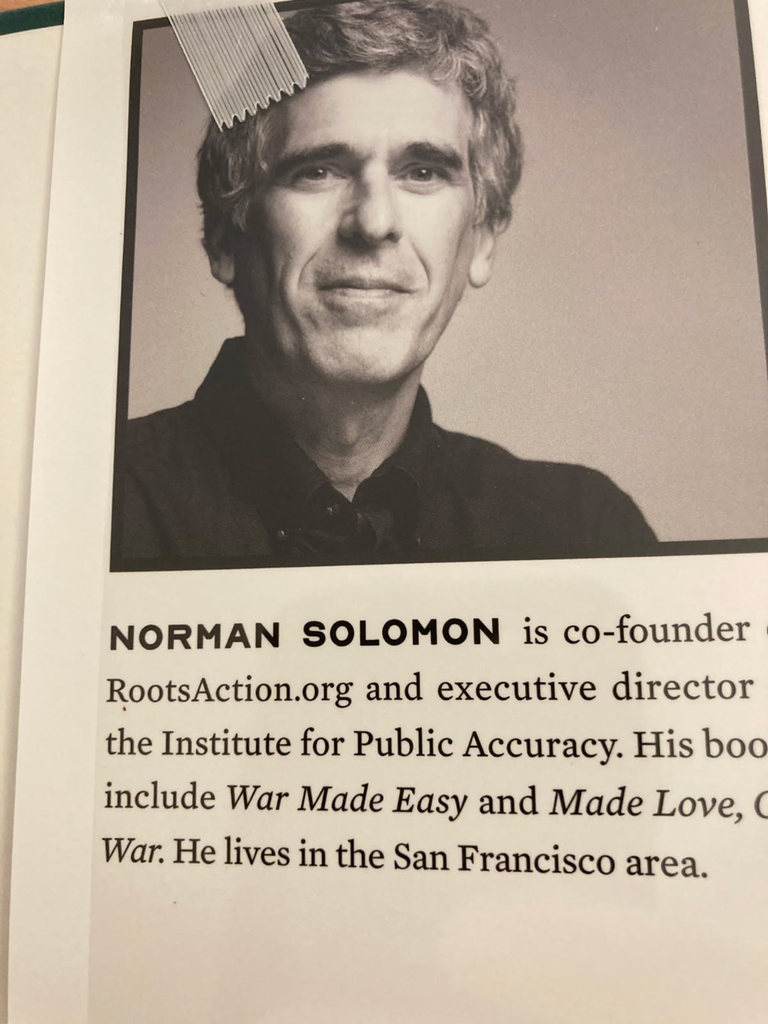
Tune in tonight to hear author/activist Norman Soloman discuss his book War Made Invisible.
With Don Kimball Sat 2pm, Wed 7pm
A Voice for and About Veterans
Tune in to Friendly Fire a Voice For Veterans and listen in as four veterans, each from a different branch of the service, discuss the exciting and informative events that took place at the 2026 Veterans for Peace four day convention. Susan Schnall, president of Veterans for Peace talks about the numerous challenges the current administration is presenting to those trying to stop endless wars, global climate change, mass deportations and a diminished VA healthcare system.
Sat 1pm
DOCUMENTING THE U.S. MEDIA’S COMPLICITY IN THE GENOCIDE OF
GAZA WITH ROBIN ANDERSEN
In Robin Andersen’s new book, she chronicles how the U.S. media utilized their massive reach to help shield Israel from scrutiny as it perpetrated a genocide in Gaza.
Chris Hedges, a former New York Times Middle East Bureau Chief, is certain about at least one thing regarding Israeli propaganda tactics: “If there is one indisputable fact, it is that Israel lies like it breathes.” The task of professional journalists and media outlets is to review evidence and verify the information they are reporting, but when it comes to Israel, Western establishment media function as stenographers, echoing their lies globally.
In this episode of The Chris Hedges Report, Hedges explores the mechanisms by which Western media function as propaganda outlets for Israel with media scholar Robin Andersen, who documented these practices in her new book, “The Complicit Lens.” They begin with a discussion of the ways media corporations control the narrative through omissions of historical context, dehumanization of Palestinians and censorship of specific words, such as “massacres.” Journalists who work for these commercial outlets are aware of their complicity — a fact corroborated by leaks detailing the propagandistic guidelines editorial departments force their journalists to follow — but sacrifice their integrity and honesty for access to those in power and to protect themselves from retaliation.
Hedges and Andersen explain the ways that media outlets manipulate language to cover up war crimes being committed by the Israelis and shift the blame for Israeli attacks on civilians and infrastructure, such as hospitals and schools, onto the victims, Palestinians themselves. Outlets engage in ‘atrocity propaganda,’ amplifying horrific lies about sexual assault and “beheaded babies” told by the Israeli State without factchecking them to generate public support for the genocide of Palestinians, who are characterized as ‘terrorists’ and members of the demonized national resistance organization, Hamas. Andersen reports, “The Israelis were presented in their whole humanity… and the Palestinians are dead bodies, and that’s it.”
Another method of information control is by limiting access. Foreign journalists are restricted from entering Gaza, and those who are allowed in are vetted by Israel in advance. In violation of international law, the Palestinian press is censored through murder. Over 270 Palestinians, including those who work for major media outlets, and their families have been targeted and killed by the Israeli military. The price that we all pay for this complicity by the media is the legitimization of genocide, the absence of accountability and the lack of reliable news sources. As Andersen concludes, our loss is that there are “fewer and fewer voices, fewer and fewer documentation [that] can make sense of this and bring it to global publics.”
Sat 2pm, Wed 7pm
A Voice for and About Veterans
Tune in at .2pm PDT to hear the best of Friendly Fire 2017-2022. Hear from veterans who have fought against almost insurmountable odds to regain their place in society after serving, and then suffering, with challenges both physical and psychological. As always, it’s been my privilege to bring you their stories.

EAST COUNTY MAGAZINE with Editor, Investigative Journalist Miriam Raftery and the East County Magazine News Team
Fri 5pm, St 8am, Mon 5pm, Tues 9am
Award-winning editor and journalist Miriam Raftery and her award-winning magazine East County Magazine focus on news and events of their area. Miriam and her news team also report news of the larger San Diego and national and international news that may affect East County.
East County Magazine has up-to-date information on wildfire and emergency news.
ABOUT EAST COUNTY MAGAZINE
East County Magazine is your community media. We reflect the public’s interest, not special interests.
OUR MISSION
Our mission is to provide in-depth news and events coverage for the inland areas in San Diego County, reflecting the broad diversity of people and issues in our region, particularly those under-represented in other media. As nonprofit media, we reflect the public interest—not special interests, with a strong commitment to covering social justice issues, diverse and mulicultural voices, community concerns, environmental/land use issues, and nonpartisan political stories in our region’s urban, rural, mountain and desert communities. We also celebrate our region’s attractions and rich cultural heritage, with special sections such as Visit East County, People Power, Tribal Beat, Refugee Voices, Arts and Music, and more.
East County Magazine also founded and operates East County Wildfire & Emergency Alerts, keeping people safe and informed throughout San Diego County via e-mail and Twitter alerts. In addition we produce the East County Magazine radio show on KNSJ 89.1 FM.
Fri 8am, Tues 7pm
Thoughtful conversations and a good way to start the day! STOP & TALK dives deep into the themes of purpose and opportunity, guided by the insights of leaders in the arts and culture, health, philanthropy, finance, and innovation fields. Together, we celebrated local achievements and envisioned what’s possible in San Diego County.